
Environmental governance in Bangladesh is shaped by intersecting pressures on its river systems, wetlands, and terrestrial ecosystems, alongside livelihoods that depend directly on natural resources. These challenges are compounded by industrial pollution, biodiversity loss, land degradation, and the accelerating impacts of climate change. It is within this demanding policy environment that Commonwealth Alumnus, Farhana Mustari has built a career focused on strengthening evidence-based environmental decision-making at national, community, and international levels—advancing work closely aligned with SDG 13 (Climate Action), SDG 14 (Life Below Water), and SDG 15 (Life on Land).
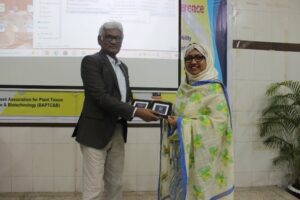
Farhana receives a memento recognising her contribution as a speaker at the 11th International Plant Tissue Culture & Biotechnology Conference, University of Dhaka, January 2026.
Over more than a decade at the Department of Environment, Farhana has worked across some of the country’s most pressing environmental priorities. Her responsibilities span ecosystem conservation, biosafety governance for modern biotechnology, and participation in international environmental negotiations. Through roles that combine technical analysis, regulatory coordination, and community engagement, she support approaches to environmental management that are grounded in scientific evidence while responsive to local realities.
Awarded a Commonwealth Shared Scholarship in 2021 to pursue an MSc in Environmental Science at the University of Aberdeen, Farhana strengthened the analytical foundations of her professional practice. The programme enhanced her capacity for evidence-based research, interdisciplinary analysis, and engagement with international governance frameworks, equipping her to navigate increasingly complex policy environments.
This scholarship changed the way I work. It taught me to focus on evidence-based research and to design projects that truly address real problems.
Since returning to Bangladesh, Farhana has applied this training across high-impact roles. She serves as Project Director of a Global Environment Facility initiative supporting the management of Ecologically Critical Areas through ecosystem restoration and community-led conservation, and as National Project Coordinator for a UNEP-implemented regional biosafety programme. She has also represented Bangladesh in United Nations processes on plastic pollution and land degradation, contributing perspectives from a climate-vulnerable, downstream country to global negotiations.
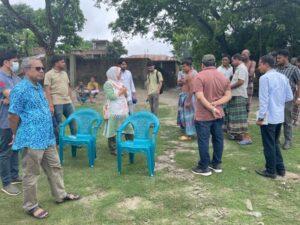
Farhana enhancing community awareness on biodiversity conservation
Through policy development, scientific reporting, community-focused implementation, and international engagement, Farhana’s work demonstrates how Commonwealth Scholars translate academic training into sustained public service. Her case study highlights the role of evidence-based environmental governance in strengthening institutional capacity, enhancing ecosystem resilience, and supporting inclusive decision-making in fragile ecological contexts.
Read about Farhana Mustari’s case study here.