
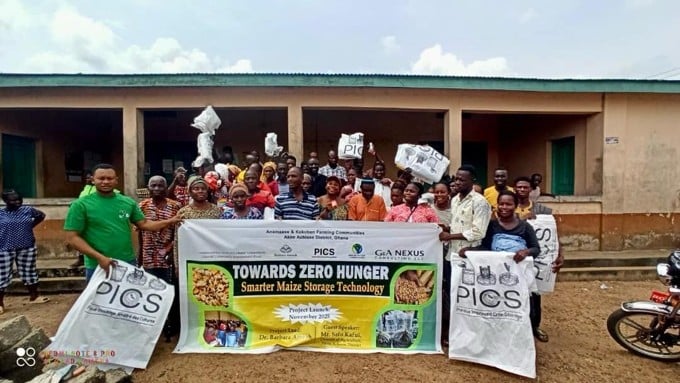
Maize is a staple crop in Ghana, vital for food security and smallholder livelihoods. However, post-harvest losses caused by maize weevils (Sitophilus zeamais) and poor storage practices reduce the quantity and quality of stored grain. As a result, many farmers sell their maize soon after harvest at low prices, while the unsafe use of synthetic pesticides during storage raises concerns about food safety and insecticide resistance. Addressing these challenges through farmer education is key to improving food security, farmer incomes, and economic resilience.

Dr Barbara Amoah
Between November 2025 and February 2026, Commonwealth Alumnus Dr Barbara Amoah led community-based workshops in Anamase and Kokoben, Akim Achiase District, Ghana. The workshops focused on building awareness and practical skills to improve post-harvest management and promote safer storage solutions.
Dr Barbara Amoah is an entomologist, Adjunct Professor, and Scientific Consultant. She supports researchers and innovators identifying, securing, and managing funding to advance scientific discovery and innovation.
Tackling post-harvest losses through capacity strengthening
Smallholder farmers in Ghana experience an estimated 30–50% post-harvest loss during storage due to insect pests. These losses reduce food availability and limit household incomes. To reduce pest damage, many farmers rely on chemical insecticides during storage, which can raise food safety concerns when pesticides are used improperly.
Dr Amoah’s activity aimed to promote safer, more sustainable post-harvest practices by strengthening local capacity through farmer training, practical demonstrations, and participatory learning.
A key component of the training was the introduction of hermetic storage technology, specifically the Purdue Improved Crop Storage (PICS) bags. These insecticide-free solutions protect grain, maintain quality, and allow farmers to store maize longer, enabling sales at more favourable market prices.
Strengthening stakeholders for sustainable maize storage
Dr Amoah’s activity was designed to span the minor and major growing months to evaluate the impact of the training. She launched the initial training sessions in November and December 2025 and conducted a post-three months’ follow-up in February 2026.
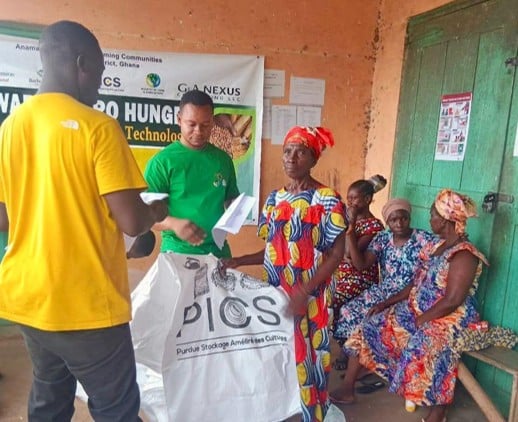 The activity engaged approximately 85 participants, including smallholder farmers, grain merchants, community members, Agricultural Extension Agents (AEAs), and district-level stakeholders across the two communities.
Dr Amoah’s activity was supported by a range of important stakeholders, including Safo Kafui, District Director of Agriculture; the Hon Regina Tewuah, Assembly Woman for Kokoben; Mr Richard Korang, Kokoben Chief Farmer; Samuel Amakye, Kokoben Community Leader; and Mr Ebo Annan, Anamase Community Leader. Their involvement reinforced the importance of local ownership in combatting post-harvest losses and highlighted their support for scaling the initiative across the district.
Dr Amoah’s project team included Zakari Birikorang and Gabriel Anakwah, both AEAs. They provided technical facilitation and coordinated the workshops, demonstrations, and farmer engagement. Additional voluntary support was provided by Evelyn Darko and staff from the District Department of Agriculture.
Promoting practical solutions through training and demonstrations
Between November 2025 and February 2026, programme activities delivered included participatory workshops combining technical training, discussions, and practical demonstrations in post-harvest management. Topics covered included maize weevil damage, the impact of poor drying and storage, risks of chemical insecticides, and improved practices such as drying, sorting, and safe storage. Facilitators highlighted how these factors contribute to significant grain losses and food safety risks.
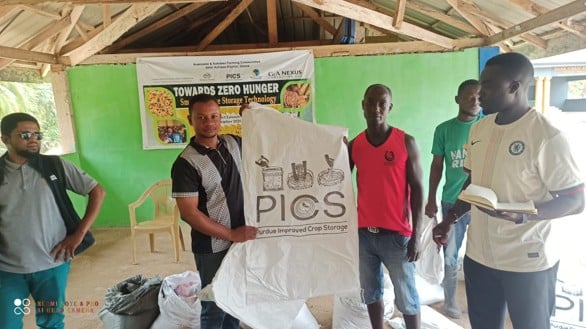
Agricultural Extension Agents Birikorang (far right) and Anakwah (2nd from left) distribute PICS bags to farmers
Dr Amoah introduced hermetic storage technology using Purdue Improved Crop Storage (PICS) bags as a safer, insecticide-free method for protecting stored maize. Following this, farmers conducted experiments using their own maize stored in both conventional and hermetic bags. A follow-up workshop three months later evaluated the results, with participants observing improved grain quality and minimal insect damage in PICS bags compared to conventional storage bags.
Discussions and Q&A sessions throughout the activities enabled farmers to share experiences and reflect on challenges such as pest infestations, grain losses, and market fluctuations. They noted that improved storage would allow longer storage and better pricing, while many expressed increased willingness to expand production if access to PICS bags improves.
Measuring impact and driving adoption of hermetic storage
Dr Amoah assessed impact through baseline and follow-up surveys, complemented by observations during training and evaluation sessions.
Next steps will focus on expanding access to hermetic bags through subsidised supply and identifying more stable maize markets. Dr Amoah aims to secure additional funding to provide PICS bags at reduced cost, while linking farmers to reliable markets to maximise the benefits of improved storage and stronger bargaining power.
Barbara Amoah is a 2009 Commonwealth Shared Scholar. She completed a MSc in Natural Resources – Sustainable Environmental Management at the University of Greenwich.